Strengthening Land Degradation Neutrality Policy through Agricultural Waste Management: Lessons from Rice Farmers in Abia State, Nigeria
POLICY
Amah Okorie
2/21/20263 min read
Nigeria’s recently validated National Policy to Combat Land Degradation and Desertification offers a renewed and strategic framework for addressing some of the country’s most pressing environmental challenges, particularly the accelerating loss of productive land caused by unsustainable land use, drought, and desertification. The validation, concluded at a national workshop in Abuja on 20 January 2026, signals a deliberate shift toward more contemporary, inclusive, and actionable environmental governance, one that speaks directly to the lived realities of farmers and pastoralists across the federation.
Speaking at the workshop, the Minister of Environment, Malam Balarabe Lawal, emphasised that the revised framework is critical for strengthening environmental sustainability and safeguarding the socio-economic stability of millions of Nigerians. The updated policy places strong emphasis on climate resilience, early warning systems, coordinated institutional action, and community engagement, priorities intended to make Nigeria’s commitments under the United Nations Convention to Combat Desertification (UNCCD) more responsive and grounded in local contexts. Importantly, the policy recognises that land degradation is not an abstract phenomenon but a material condition that directly affects agricultural productivity, water availability, food security, and socio-economic stability across the country.
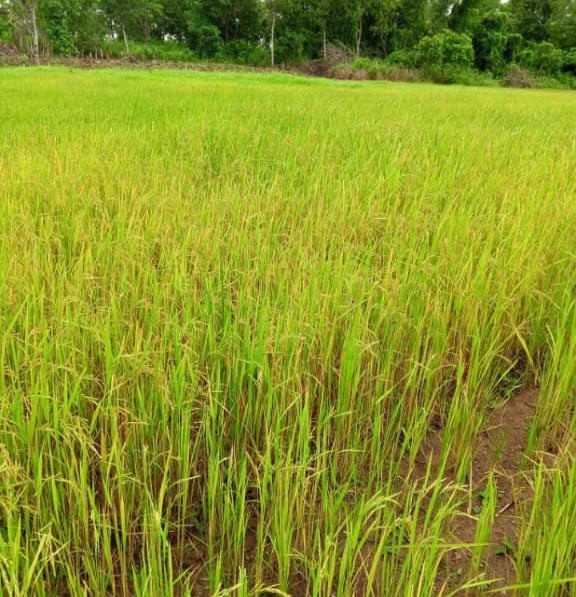
In Abia State’s rice-producing communities, the management of agricultural waste, particularly rice residues, offers a subtle but powerful lens for examining how national environmental policy translates into everyday land-use decisions. The updated national policy framework identifies multi-sectoral partnerships and active local participation as essential to successful implementation. Yet what does this look like in practice for smallholder rice farmers whose fields are simultaneously sites of residue accumulation, erosion risk, and soil fertility dynamics?
Across many farming communities in Abia State, rice residues are routinely burnt after harvest to clear fields quickly in preparation for the next cropping cycle. From an agronomic perspective, this practice accelerates soil degradation through the loss of organic matter and increased susceptibility to erosion. From the farmer’s standpoint, however, burning represents a pragmatic response to labour constraints, time pressures, and the absence of viable alternatives. In the absence of adequate institutional or technical support, residues are perceived as obstacles rather than resources, even though their retention or reuse could significantly enhance soil health and align with the restorative land management principles emphasised in the revised national policy.
By foregrounding agricultural waste management as a policy interface, it becomes evident that rice production practices are not merely technical behaviours but indicators of how policy design and implementation are experienced at the field level. The national policy’s emphasis on climate resilience and coordinated institutional action underscores a strategic imperative to bridge the policy-to-practice divide, particularly in contexts where land degradation directly shapes food systems and rural livelihoods.
Lessons from the Field for Policy Implementation
Policy Intent Requires Local Translation
While the updated national policy emphasises inclusivity and multi-sectoral collaboration, the continued reliance on residue burning among rice farmers reveals a persistent gap between policy intent and everyday practice. This gap is less a matter of ignorance than of implementation design. National ambitions must be translated into locally viable strategies that align with farmers’ seasonal decision-making and resource constraints. Practical measures such as access to residue-management machinery, the development of biomass markets, and subsidies for mulching or composting inputs would make policy objectives actionable at the field level.Institutional Coordination Must Reach the Ground
The policy calls for coordinated action across government, the private sector, civil society, and local communities. Yet at the village level, extension services often operate as isolated providers of advice rather than as partners in policy implementation. Strengthening linkages between national policy structures and community-based institutions, including farmer cooperatives, would help embed Land Degradation Neutrality (LDN) principles into routine agricultural practice and foster shared responsibility for sustainable land management.Resilience Frameworks Must Account for Farm-Level Realities
Climate and land resilience form a cornerstone of Nigeria’s revised policy framework. Within rice production systems, this requires reconceptualising residues not as waste to be eliminated, but as potential contributors to soil organic matter, moisture retention, and long-term resilience to degradation. Integrating residue retention and reuse into resilience planning would better align national climate goals with the ecological realities of smallholder farming systems.Monitoring and Early Warning Systems Must Include Agriculture
The policy’s emphasis on early warning systems and monitoring mechanisms should extend more explicitly to agricultural landscapes where degradation is ongoing. Incorporating indicators related to residue management, soil cover, and organic inputs into monitoring frameworks would enable policymakers to better capture farm-level drivers of land degradation and to design timely, evidence-based interventions.
Integrating Policy with Practice
Nigeria’s updated National Policy to Combat Land Degradation and Desertification marks a significant step toward more responsive and accountable land governance. Its emphasis on resilience, institutional coordination, and community participation creates an enabling framework for advancing land degradation neutrality. However, the experiences of rice farmers in Abia State underscore the need for national frameworks to be operationalised through supportive, context-sensitive mechanisms that bridge the divide between far-reaching policy ambitions and everyday agricultural decision-making.
Rice residue management may appear modest in scale, yet it exemplifies the kinds of practices that determine whether land continues to degrade or is managed sustainably. Aligning such field-level practices with national and international policy goals requires more than the articulation of targets alone. It demands adaptive, inclusive, and actionable policy pathways that meaningfully engage farmers’ lived realities and translate environmental commitments into practical change on the ground.