Reflections on Waste, Land Degradation, and Environmental Governance
When farmlands become a dumpsite
ENVIRONMENT
Okorie Amah
1/16/20265 min read
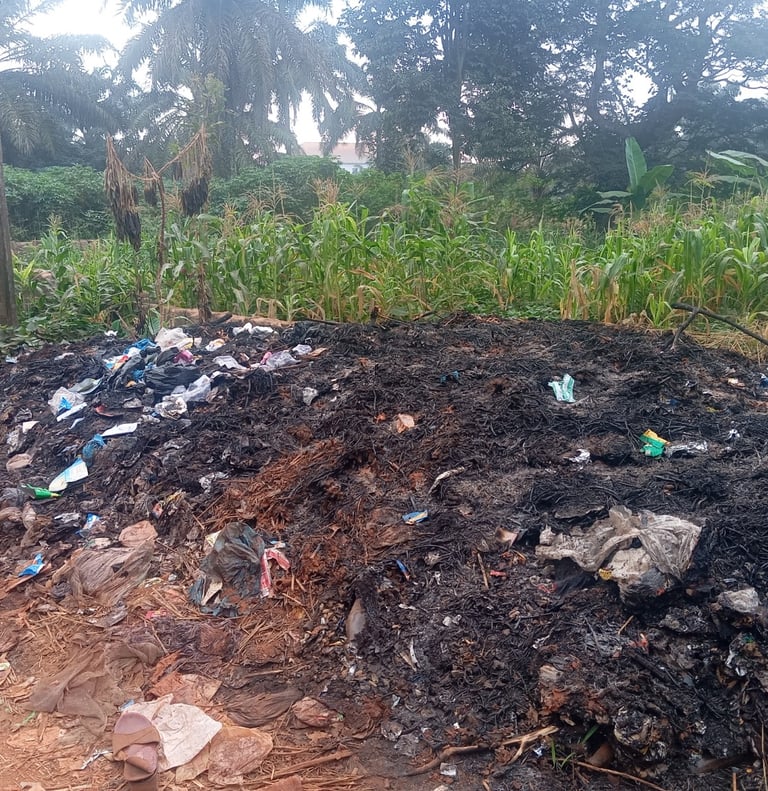
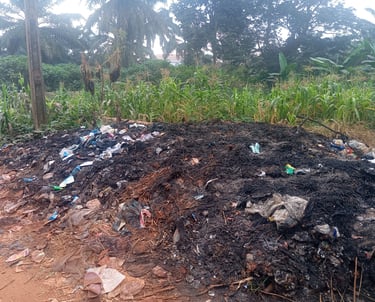
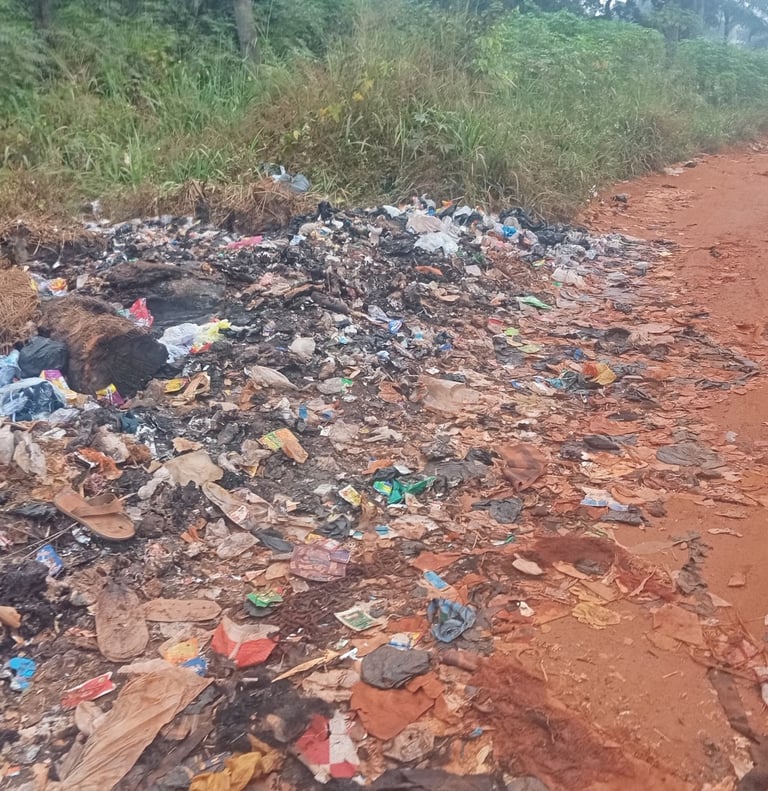
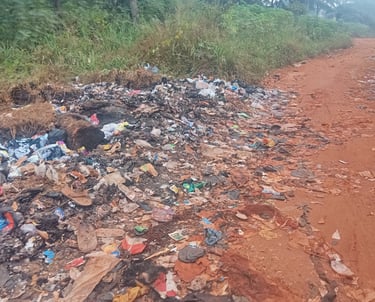
At first glance, the scene appears ordinary—a stretch of rural farmland like many others. But a closer look tells a troubling story. The soil that should nurture crops is scattered with household refuse. Some of the waste has been partially burnt, leaving blackened patches on the ground, while other materials remain intact: plastic bottles, nylon bags, rusted cans, and fragments of everyday human consumption. What ought to be a space for food production has quietly transformed into an informal dumpsite. This image, taken in farmland at Amammiri Ihechiowa, a community in one of the southeastern states of Nigeria, is more than just a photograph of litter. It is a visual representation of a growing ecological crisis and a window into the complex relationship between human behaviour and the environment.
The Quiet Damage of Waste on Agricultural Land
Farmland is a critical natural resource. In rural communities especially, it forms the foundation of livelihoods, food security, and cultural identity. Yet across many developing regions, agricultural land is increasingly treated as a convenient site for waste disposal. When refuse encroaches on farmland, the damage extends beyond environmental aesthetics; it fundamentally undermines soil health. Non-degradable materials such as plastics and metals disrupt soil structure and reduce fertility. Toxic substances from decomposing waste can seep into the ground, contaminating both soil and groundwater. Burning refuse, as seen in this case, introduces another layer of harm by releasing hazardous gases into the atmosphere and leaving residues that further degrade the land. What emerges is a cycle of environmental neglect: degraded soil leads to poor crop yields, which in turn deepen rural poverty and food insecurity. The land meant to sustain life gradually loses its capacity to do so.
Human Ecology and the Culture of Disposal
This scene also forces a confrontation with an uncomfortable truth about human ecology. Environmental degradation is rarely accidental; it is often the product of everyday choices and social habits. The decision to dump refuse on farmland or to burn waste openly reflects deeper issues of awareness, attitude, and governance. In many rural communities, especially in southeastern Nigeria, formal waste management systems are weak or entirely absent. Without access to organised collection services or designated disposal sites, people resort to the easiest available option: open dumping. Over time, this practice becomes normalised. What begins as an individual act of convenience evolves into a collective behaviour with serious ecological consequences. Human ecology reminds us that people and their environment exist in constant interaction. When human behaviour becomes careless or uninformed, the environment inevitably bears the burden.
Environmental Governance: The Missing Link
Scenes like this highlight a significant gap in environmental governance. Effective governance is not only about creating laws; it is about ensuring that systems exist to manage waste, protect land, and guide community behaviour. Critical questions emerge: Where are the local waste collection points? Where are the recycling initiatives? Where are the community bylaws that prevent farmland from becoming a dumping ground?
Environmental governance requires coordination among government agencies, community leaders, and citizens. Policies must be translated into practical action through public education campaigns, the provision of waste bins, the enforcement of environmental regulations, and the promotion of sustainable alternatives such as composting and recycling. Without governance structures that prioritise environmental protection, rural landscapes will continue to suffer silent degradation.
From Awareness to Behavioral Change
Perhaps the most important lesson from this image is the need for behavioral change. Cleaning up waste is important, but preventing it in the first place is even more critical. Real transformation begins when individuals come to see farmland not as empty space for disposal but as a valuable ecological asset.
Behavioral change in human ecology involves:
teaching communities about the long-term impacts of improper waste disposal;
encouraging responsible consumption and reduced use of plastics;
promoting composting of organic waste instead of open burning;
developing community-driven waste management initiatives;
fostering a sense of environmental stewardship among young people.
When people understand that today’s careless actions can destroy tomorrow’s harvests, attitudes begin to shift.
A Call to Protect What Sustains Us
To stand before farmland littered with waste is to witness more than environmental neglect; it is to encounter a rupture in the delicate relationship between people, land, and memory. Rural landscapes are not empty backdrops upon which life merely unfolds. They are living archives, holding generations of labour, tradition, and ecological wisdom. Every plot of cultivated soil carries stories of seasons endured, seeds saved, and knowledge passed quietly from one generation to the next. When such land is reduced to a dumping ground, something deeper than physical degradation occurs: a fragment of cultural heritage is diminished.
The mission of Rural Muse is rooted in the belief that rural spaces deserve to be understood in their full humanity, as places where culture, ecology, and livelihood intersect. Farmlands function as classrooms where indigenous knowledge systems teach sustainable coexistence with nature. Streams, forests, and fields are repositories of collective memory. They sustain not only bodies through food but also identities through tradition. Protecting these landscapes, therefore, is not simply an environmental responsibility; it is an act of cultural preservation.
Across many rural communities, improper waste disposal has become normalised not because people do not care about their environment, but because changing social and economic pressures have disrupted traditional practices. Plastic and other non-degradable materials have entered villages faster than systems to manage them. Older methods of composting and organic reuse are increasingly displaced by consumer habits imported from urban life. In this transition, the wisdom of the past is often pushed aside. Yet rural communities have long been custodians of sustainability. Well before modern environmental policies emerged, farmers understood the importance of conserving soil, protecting water sources, and respecting the balance of nature. These local knowledge systems remain powerful tools for addressing contemporary ecological challenges, if they are recognised and revitalised.
A call to protect what sustains us is therefore also a call to listen. It is a call to attend to the voices of farmers who understand how waste chokes the fertility of their fields; a call to elders who remember when every scrap had a purpose and nothing was casually discarded; and a call to young people to reclaim pride in caring for the land rather than contributing to its decline. Environmental governance must begin with this cultural awareness. Policies and regulations are important, but they become truly effective only when rooted in the lived realities of rural people. Waste management initiatives that ignore local context will struggle to succeed, while those that engage communities, respect indigenous practices, and build on existing knowledge can inspire genuine behavioural change.
To protect what sustains us is to honour the land as more than soil. It is to see it as heritage, as teacher, and as a partner in survival. It is to recognise that sustainability is not a foreign concept imposed from outside but a principle long embedded within rural ways of life.
If this understanding can be rekindled—if communities and leaders begin to treat rural landscapes as the living archives they truly are—then scenes of farmland turned into dumpsites will no longer be common sights. Instead, they will stand as reminders of a path deliberately not taken.
The future of our environment depends on this choice.
So does the future of our stories.